

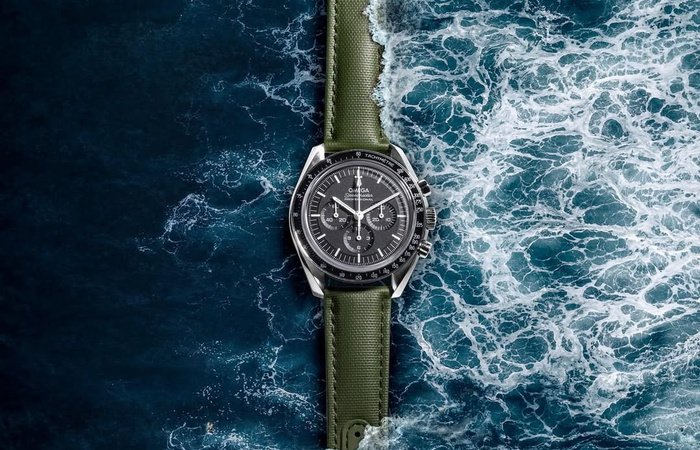
Most strap materials have an obvious origin. Leather came from saddlery, nylon from military kit, rubber from diving. Sailcloth is the odd one. It came from boats, and it came to watches sideways, through owners who wanted something leather couldn’t give them.
The first sailcloth straps were cut from the real thing. Sail fabric is woven to resist stretch, salt, sun and constant flexing, and the owners of big dive watches noticed that those were exactly the qualities a strap needed. Someone cut a strip from an old sail, stitched a buckle on, and found it was lighter than leather, tougher than canvas and indifferent to water. The look caught on before the material was ever refined.
The problem with real sail fabric is that it behaves like fabric. It frays at the holes, holds water in the weave, and goes limp after a season. The straps looked right and wore wrong. What followed was a decade of makers trying to keep the look while fixing the material.
The answer most of them arrived at was to separate the two. The surface would carry the sailcloth pattern. The structure underneath would be something else. The modern sailcloth strap is an embossed synthetic upper, pressed with the fine grid of a yacht sail, bonded over a core that gives it shape and a lining that sits against the skin. That construction is what people mean today when they say sailcloth, and it’s why a sailcloth strap now holds its edges, dries quickly and keeps its structure through years of wear.
Artem Straps built its reputation on this version. The brand’s sailcloth watch straps use an embossed upper with a satin finish, a leather core for body, and a natural rubber underside that keeps the strap comfortable in heat and resistant to sweat. It’s a strap that looks like sail fabric and wears like something engineered.
Why did sailcloth outlast the trend that started it?
The first is that it sits between categories. Leather is formal. Rubber is sport. Nylon is casual. Sailcloth is the only strap that can go to the office on Monday and the beach on Saturday without looking wrong in either place. The texture reads as considered, the padding reads as substantial, and the color range runs from black and navy through to sand beige and khaki. A diver on sailcloth under a shirt cuff looks like a choice. A diver on rubber under a shirt cuff looks like you forgot to change.
The second is water. Sailcloth straps of the modern kind are water resistant rather than waterproof, which turns out to be the right amount for most people. Rain, sweat, washing your hands and the occasional splash do no harm. That covers the vast majority of days a watch gets worn. The days that need more than that are the days for rubber, and Artem’s HydroFlex rubber straps carry the same sailcloth texture so the watch looks the same whichever is on.
The third is the way sailcloth ages. Leather develops patina and some people love that and some don’t. Rubber looks the same forever. Sailcloth sits in the middle. The embossed surface doesn’t fade or fray, but the strap molds to the wrist over the first few weeks and the stitching softens a touch, so it ends up feeling like it was made for you without ever looking worn.
There’s also a quieter reason, which is that sailcloth photographs well. The grid catches light in a way smooth materials don’t, and the contrast stitching most sailcloth straps carry gives the wrist something to look at. A lot of the sailcloth boom was driven by pictures, and the pictures were honest. The strap looks in person the way it looks on screen.
What sailcloth never became is a dress strap. On a thin gold watch it looks like the wrong idea, and the people who make it know that. It’s a strap for watches with some presence, which is why it turns up most on divers, chronographs and sports watches between 38mm and 44mm.
If you’ve never owned one, the Classic version with a tang buckle is the place to start. It comes in five base colors with a range of stitching, in lug widths from 19mm to 23mm, with quick release spring bars fitted and a two year warranty. Put it on a black dial diver and you’ll understand in about a day why a material that started on a boat ended up on so many wrists.
Leave a Reply