

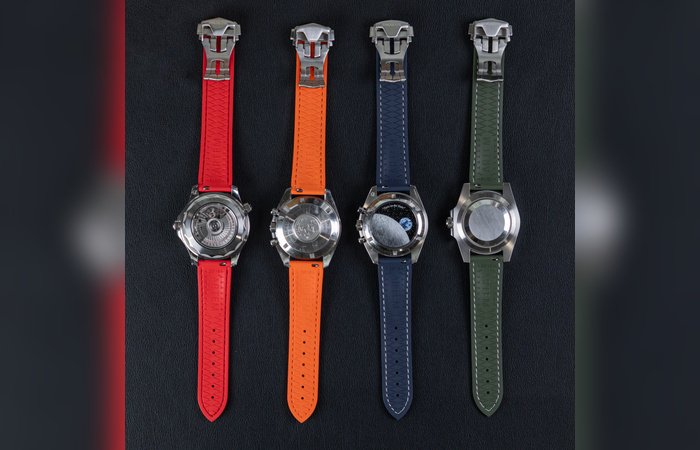
Ask ten collectors whether rubber or leather is the better strap and you’ll get ten answers, all of them about the collector rather than the strap. That’s because the question has no general answer. It has a personal one, and it comes down to a handful of things about how you live with the watch.
Here are the five questions that settle it, followed by what to look for once you’ve decided.
1. Where does the watch go in a normal week?
Not where you’d like it to go. Where it actually goes.
If the honest answer includes a pool, a gym, a beach, a kitchen sink or a humid commute, the strap is going to get wet on a regular basis, and leather doesn’t forgive that. Sweat stiffens it, water marks it, and repeated soaking cracks it. Rubber doesn’t care about any of it.
If the honest answer is a desk, a car and the occasional restaurant, leather will be fine and will look better than rubber in every one of those places.
Most people’s week includes some of each, which is why the real answer for a lot of owners is both, and a set of quick-release spring bars.
2. Does the watch need to pass as formal?
Rubber has a ceiling. A slim black rubber strap on a sports watch can get through a relaxed office. It can’t get through a wedding, a funeral or a meeting where everyone else is in a suit.
Leather has no ceiling. A dark leather strap on almost any watch is acceptable anywhere, and on a dress watch it’s the only option that looks right. If the watch is ever expected to be the formal watch, leather has to be in the rotation.
3. Do you want the strap to stay the same, or change?
This is the question people forget to ask.
A rubber strap looks the same on day one and day five hundred. For a lot of owners, that’s exactly the point: it’s a tool, and tools should be consistent.
A leather strap changes. The surface darkens where your palm rests, the edges pick up a sheen, and the holes you use most often soften first. Owners who love leather love it for this. Owners who want their watch to look new forever find it unsettling. Decide which you are before you buy, because it’s the difference between a strap that becomes yours and a strap that looks worn out.
4. How do you feel about a break-in period?
Good rubber is comfortable immediately. There is no break-in, and if a rubber strap feels stiff, the compound is wrong.
Most leather needs time. A week or two of wear before it stops fighting the wrist is normal, and cheap leather can take longer. The exception is a small number of premium hides, French Barenia® being the best known, that are tanned to feel supple from the first day. If the stiffness of leather is what’s kept you on rubber, it’s worth knowing that it isn’t universal.
5. Which clasp do you want to live with?
Both materials work with a traditional pin buckle and with a deployant clasp, but they benefit differently.
On rubber, a clasp is mostly convenience: the strap goes on in one click. On leather, a clasp is protection. Pulling leather through a buckle every morning is what wears the holes and creases the fold, and a deployant removes that entirely. If you’re going with leather and plan to keep it for years, build it around a clasp.
What to look for once you’ve chosen rubber
The compound is everything. Silicone is soft and cheap, and it collects lint, tears at the spring bar holes and goes sticky in heat. Natural vulcanised rubber is better. FKM, a fluoroelastomer, is the one to look for: UV-stable, salt-proof, sunscreen-proof, and still flexible years on.
Then look at the shape. A rubber strap should taper, should be curved to sit flat against the wrist, and should have a textured or embossed surface if you want it to look like more than a tool. Artem’s rubber watch straps, the HydroFlex™ range, are a good reference point: dual-stage vulcanised FKM, a sailcloth-style embossed finish, a 5.4mm to 2.2mm taper, and the Loop-less™ construction that pairs with a folding clasp and leaves no keepers or tail. Thirteen colour editions, sizes from 18/16mm to 23/20mm, fitted quick-release spring bars.
What to look for once you’ve chosen leather
Full-grain hide with a light finish, so it can develop patina rather than crack. Sealed or burnished edges. Stitching that sits flush. Hardware in solid stainless steel. And, ideally, a strap that was designed around a deployant clasp rather than adapted to one.
Artem’s leather watch straps tick each of those. The Barenia® collection uses French full-grain Barenia® leather in three tonal editions, Saddle Tan, Bridle Brown and Forge Black, each cut for the same Loop-less™ clasp as the rubber range. The tan shows patina fastest; the black is the most formal; the brown is the one that goes with everything.
The answer most people land on
One rubber strap for the days the watch gets wet. One leather strap for the days it needs to look its best. The same clasp, moved between them, and quick-release bars so the swap takes thirty seconds.
That isn’t a compromise. It’s the only arrangement that lets a single watch do everything you want it to.